Betting on All -in-One: Why Centralizing Event Management Matters
Organizing a business event today involves a multitude of technological tools. Between registrations, ticketing, participant management, programming, and communications, teams often have to juggle several different platforms.
At first glance, this approach seems logical, since each tool addresses a specific need. Yet as events grow in complexity, the multiplication of systems becomes a real operational challenge. Teams end up spending more time managing technology than focusing on the participant experience.
In this context, more and more organizations are choosing to centralize the management of their event within a single platform in order to simplify operations and improve data reliability.
When several tools are used to manage an event, the main difficulty is reconciling the data. Information ends up scattered across different systems, which often forces teams to perform manual consolidations to obtain a reliable overall picture.
Registrations and ticketing may be managed in one tool, participant profiles in another, while programming or certain operational data are stored in Excel files.
Each data transfer adds additional handling and increases the risk of errors. Over time, information can become unsynchronized, making it difficult to maintain a clear view of the event.
Take the example of a trade show with several hundred participants. If registration lists, badges, and participation data come from different systems, teams must constantly verify and adjust the information. This situation slows down decision-making and complicates overall project management.
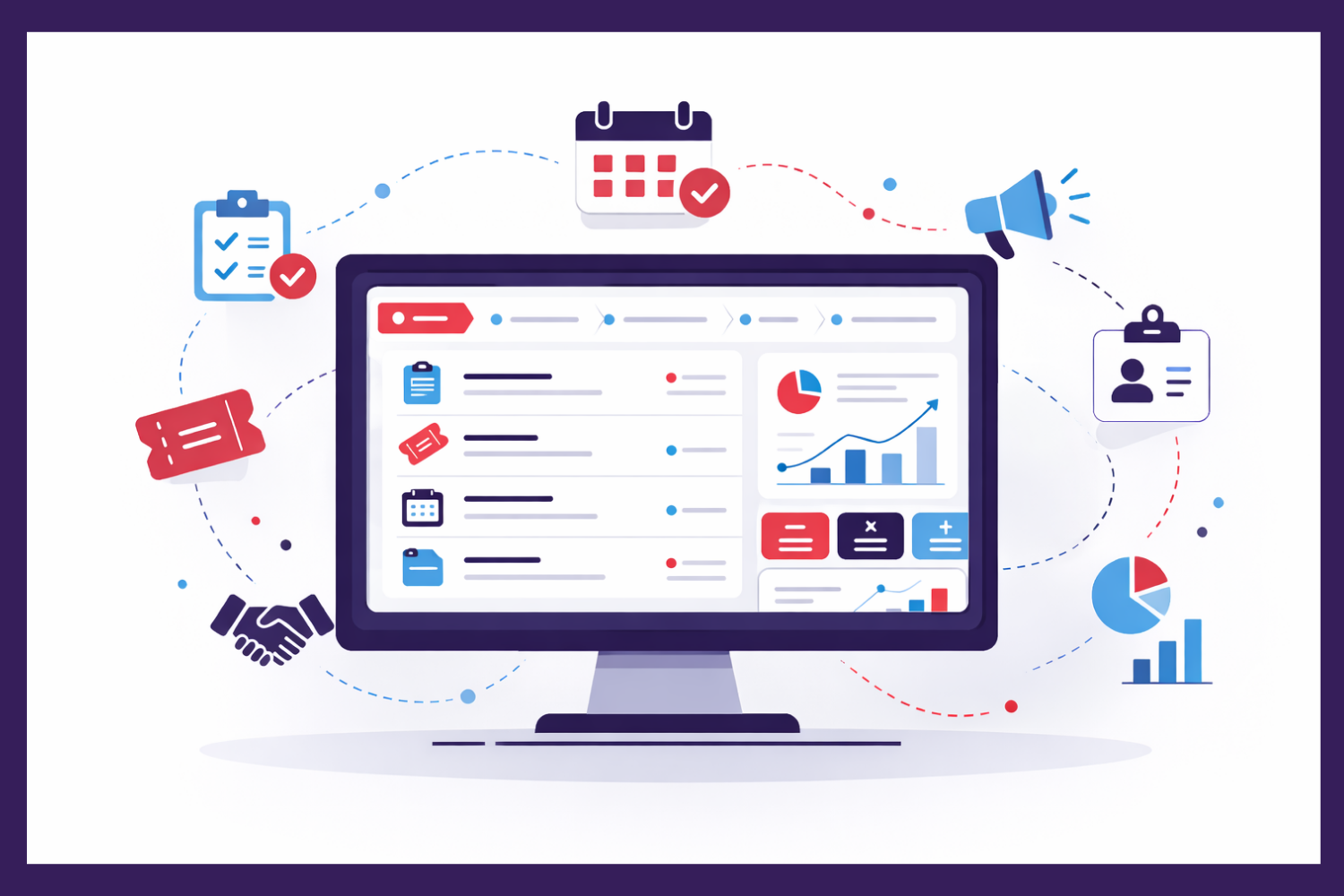
A centralized platform makes it possible to bring together essential operations in a single environment. Registrations and ticketing, participant profiles, programming, and several operational aspects are managed within the same system.
Organizers can track the progress of their event from an administration console that provides an overview of the project. Registrations, ticket sales, and created profiles can be viewed in real time, making monitoring and decision-making easier.
By bringing data together in one system, teams gain a clear and consistent view of their event without having to consolidate multiple sources of information. This approach is relevant for a wide range of event types.
Centralizing information directly improves data reliability and operational fluidity. Teams no longer need to constantly export and import participant lists between multiple systems.
Because the information is synchronized within a single platform, updates are immediate and human errors are reduced. Organizers can also access statistics and reports more easily to analyze participation and measure the results of the event.
This integration also simplifies on-site operations. During check-in, for example, participant data is directly linked to the accreditation and badge process, making it possible to track the printing and distribution of badges without additional handling.
Last-minute registrations can be integrated quickly, and teams can run tests before the event to validate the process. Check-in becomes faster, waiting lines decrease, and the first impression for participants is more professional.
A centralized platform supports organizers at every stage of the event lifecycle.
Before the event, teams can track registration progress and manage participants within a single environment. During the event, statistics and reports provide a real-time overview of participation and activities.
After the event, this data becomes a valuable tool for analyzing results and maintaining connections with participants through communications and notifications.
For participants, this approach translates into a simpler and more consistent experience. Instead of navigating between multiple platforms, they interact with a single environment accessible through their personal dashboard and sometimes even through a mobile application.
Centralizing event management is therefore not only about simplifying operations. It is also a strategic lever that improves data reliability, organizational agility, and the quality of the experience offered to participants.
In a context where events are becoming increasingly complex, a centralized approach allows teams to focus on what truly matters: creating more effective connections, delivering a professional experience, and strengthening the impact of each edition.
At first glance, this approach seems logical, since each tool addresses a specific need. Yet as events grow in complexity, the multiplication of systems becomes a real operational challenge. Teams end up spending more time managing technology than focusing on the participant experience.
In this context, more and more organizations are choosing to centralize the management of their event within a single platform in order to simplify operations and improve data reliability.
The challenge of fragmented tools
When several tools are used to manage an event, the main difficulty is reconciling the data. Information ends up scattered across different systems, which often forces teams to perform manual consolidations to obtain a reliable overall picture.
Registrations and ticketing may be managed in one tool, participant profiles in another, while programming or certain operational data are stored in Excel files.
Each data transfer adds additional handling and increases the risk of errors. Over time, information can become unsynchronized, making it difficult to maintain a clear view of the event.
Take the example of a trade show with several hundred participants. If registration lists, badges, and participation data come from different systems, teams must constantly verify and adjust the information. This situation slows down decision-making and complicates overall project management.
The centralized platform as a solution
A centralized platform makes it possible to bring together essential operations in a single environment. Registrations and ticketing, participant profiles, programming, and several operational aspects are managed within the same system.
Organizers can track the progress of their event from an administration console that provides an overview of the project. Registrations, ticket sales, and created profiles can be viewed in real time, making monitoring and decision-making easier.
By bringing data together in one system, teams gain a clear and consistent view of their event without having to consolidate multiple sources of information. This approach is relevant for a wide range of event types.
Simplified data, operations, and check-in
Centralizing information directly improves data reliability and operational fluidity. Teams no longer need to constantly export and import participant lists between multiple systems.
Because the information is synchronized within a single platform, updates are immediate and human errors are reduced. Organizers can also access statistics and reports more easily to analyze participation and measure the results of the event.
This integration also simplifies on-site operations. During check-in, for example, participant data is directly linked to the accreditation and badge process, making it possible to track the printing and distribution of badges without additional handling.
Last-minute registrations can be integrated quickly, and teams can run tests before the event to validate the process. Check-in becomes faster, waiting lines decrease, and the first impression for participants is more professional.
Management before, during, and after the event
A centralized platform supports organizers at every stage of the event lifecycle.
Before the event, teams can track registration progress and manage participants within a single environment. During the event, statistics and reports provide a real-time overview of participation and activities.
After the event, this data becomes a valuable tool for analyzing results and maintaining connections with participants through communications and notifications.
For participants, this approach translates into a simpler and more consistent experience. Instead of navigating between multiple platforms, they interact with a single environment accessible through their personal dashboard and sometimes even through a mobile application.
Centralizing event management is therefore not only about simplifying operations. It is also a strategic lever that improves data reliability, organizational agility, and the quality of the experience offered to participants.
In a context where events are becoming increasingly complex, a centralized approach allows teams to focus on what truly matters: creating more effective connections, delivering a professional experience, and strengthening the impact of each edition.